
Today in AI4 min read
TypeSafe Launches Jev, an AI Model Built to Decide Instead of Chat
TypeSafe’s Jev is an AI model built for structured decisions instead of chat. Here’s how it could improve lead qualification, workflow automation, scoring and business software.

Former OpenAI researcher Diogo Almeida is betting that the next major AI breakthrough won’t come from better conversations — but from faster decisions inside software.
TypeSafe AI has emerged from stealth with Jev, the company’s first public “System One Model,” designed to return structured decisions rather than generate text.
The model entered early access this week after TypeSafe spent roughly two years developing a new architecture and training approach called Reinforcement Learning for Calibrated Decisions, or RLCD.
The company was founded by Diogo Almeida, a former OpenAI researcher who worked on instruction-following and RLHF research that contributed to the development of ChatGPT.
Jev doesn’t write
The most unusual thing about Jev is what it does not do.
It doesn’t generate prose.
It doesn’t behave like a chatbot.
Instead, developers define possible outputs in advance and Jev returns a typed result along with probabilities and confidence estimates.
A query could look conceptually like this:
Input:
Customer support message

Question:
Which department should handle this?

Options:
Billing
Technical
Sales
Cancellation

Output:
Billing
Confidence: 96%
The result can then be consumed directly by software.
TypeSafe describes the architecture as: unstructured state in, typed probabilistic decisions out.
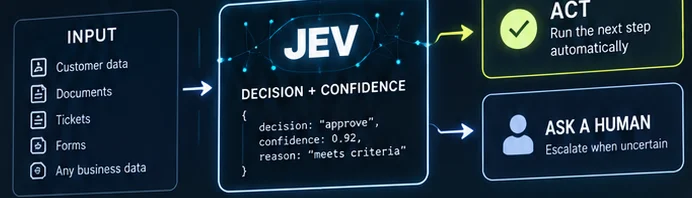
That design puts Jev in a different category from general-purpose language models, which typically generate strings of text that software must subsequently parse or validate.
Built for software, not people

TypeSafe argues that today’s language models were optimized primarily to communicate with humans.
Jev is instead intended to be used by machines.
The company lists potential workloads including:
- classification
- routing
- scoring
- information extraction
- workflow branching
- large-scale data processing
- real-time decisions
- AI output verification and guardrails
These are tasks businesses already use LLMs for, but often without needing a generated response.
TypeSafe claims major speed and cost gains
TypeSafe says Jev can complete some structured decision workloads in roughly 70 to 500 milliseconds.
Its published benchmarks claim performance ranging from approximately 40x to 200x faster than frontier LLMs on comparable System One workloads.
The company currently lists pricing of $0.042 per million input tokens — or $42 per billion input tokens — and does not charge for output tokens because Jev does not generate conventional text responses.
TypeSafe’s homepage highlights benchmark figures as high as 193.6x faster and 444.6x cheaper in selected workflows. The company itself notes that these represent the higher end of its observed gains and that the workflow evaluations were produced internally, meaning independent testing will be important.
Confidence is part of the output

Another key feature is calibrated uncertainty.
Jev returns confidence information alongside its decisions.
That lets developers build thresholds into applications.
For example:
95% confidence
→ automatically process

75% confidence
→ request more information

45% confidence
→ send to human
TypeSafe argues that this makes the model more suitable for automation because the surrounding application can explicitly determine how much uncertainty it will tolerate.
Why this matters
AI companies have spent the last several years competing to build models that can reason, write, code and communicate more effectively.
Jev represents a different bet.
Many software applications do not need an AI to write anything.
They need it to answer questions such as:
- Is this fraud?
- Which customer should we contact?
- Where should this support request go?
- Is this lead qualified?
- Does this document meet our criteria?
- Should the workflow continue?
For these applications, generating tokens one after another may be unnecessary overhead.
TypeSafe is betting that decision-specific models can become a cheaper and faster layer inside ordinary software.
Not a replacement for LLMs

There is an obvious trade-off.
Jev cannot generate arbitrary text.
That means it cannot replace ChatGPT, Claude or Gemini for many general-purpose tasks.
Instead, the model is designed to complement them.
A future application might use one model to understand and communicate with a user, while another model like Jev decides what the software should do next.
USER
↓
LLM
Understand + communicate
↓
JEV
Decide
↓
SOFTWARE
Act
That could become an increasingly common architecture as AI applications move from demonstrations into production systems.
AI may be becoming less visible
Jev also points toward a broader shift in artificial intelligence.
The most visible AI products today are conversational.
The next generation may be embedded much deeper inside software.
Models could quietly make millions of routine decisions without users ever interacting with them directly.
That could include everything from ranking leads and routing customer requests to detecting suspicious behavior and prioritizing business processes.
TypeSafe’s central thesis is that automation, rather than conversation, may ultimately be where AI creates its largest economic impact.
Whether Jev’s performance claims hold up across real-world workloads remains to be seen.
But the idea behind it is notable.
The next major AI interface might not be a chat box.
It might be an if statement with intelligence behind it.
Learn this with us
AI Tech Training
The hands-on track — agents, prompts and the workflows that run them.
Start AI Tech TrainingAI Business Training
The operator track — where AI saves hours and wins more customers.
Start AI Business Training