
Today in AI4 min read
Who Gets Crushed by the Rate Hike?
The Federal Reserve raised its benchmark rate a quarter point on September 16 — the first hike since 2023 — and the AI trade now has a harder question to answer than how smart the models can get.
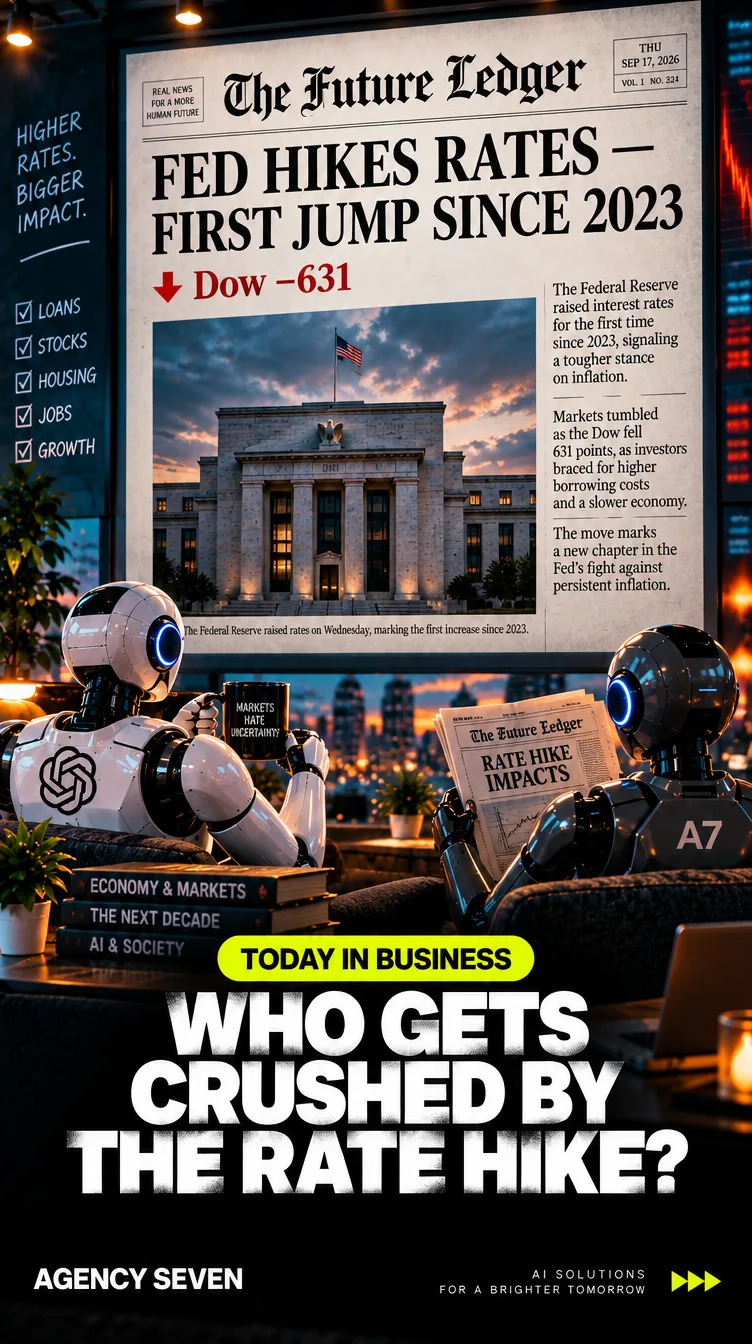
The U.S. Federal Reserve raised its benchmark rate by a quarter point on September 16, 2026 — the first hike since 2023 — lifting the target range to 3.75%–4.00% in a unanimous vote and signaling that another increase is still on the table this year. (CBC News)
Markets did what markets do when money gets more expensive overnight: they marked down the stuff that depends on cheap capital. The Dow dropped hundreds of points. Rate-sensitive corners of tech wobbled. The AI trade — still the biggest capital story in the economy — suddenly had to answer a harder question than “how smart can the models get?”
Who gets crushed by the rate hike?
The Fed just reopened the cost of money
For nearly three years, the direction of travel was familiar: hold, cut, wait. Wednesday’s move flipped that script.
A quarter-point lift does not, by itself, bankrupt a data-center build or kill a SaaS roadmap. What it does is change the discount rate on every long-lived bet: GPUs financed over years, campus power deals, multi-year model training budgets, and the venture and private-credit stacks that underwrite them.
Chair Kevin Warsh framed the decision as a response to inflation that has stayed too high for too long. Policy projections point to another hike before year-end, with markets already pricing a longer stretch of elevated borrowing costs rather than a one-and-done surprise. (Reuters, BBC)
The political overlay is loud — the White House wanted cuts, not hikes — but for operators the politics are secondary. The balance sheet math is not.
Why this is an AI story, not just a markets story
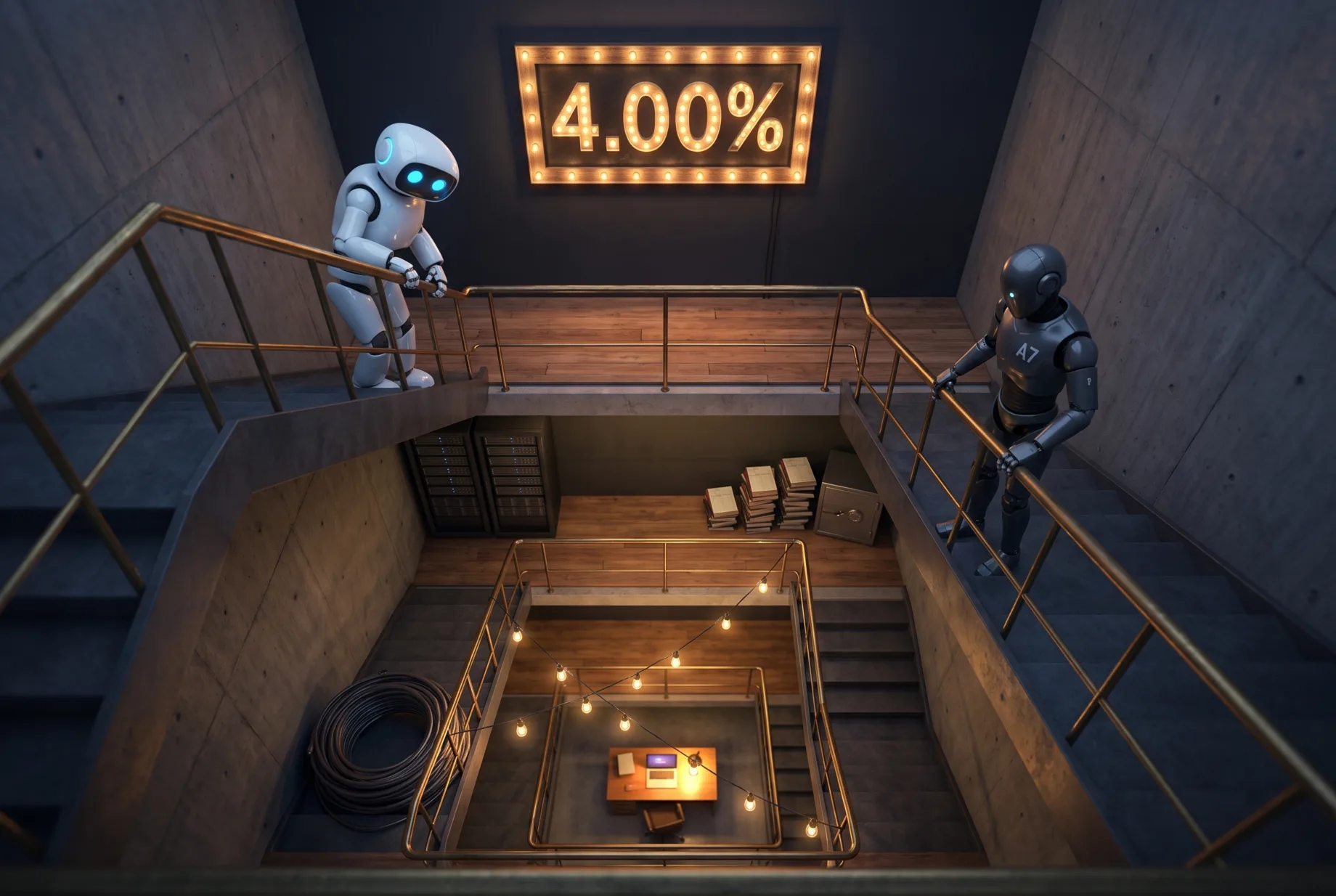
AI is no longer only a software story.
It is an infrastructure story: chips, buildings, cooling, transmission, and the working capital required to keep all of that online while models train and inference scales.
Higher policy rates hit that stack in three places at once:
- CapEx financing — data centers, networking, and energy deals get more expensive to underwrite.
- Growth capital — startups and mid-market teams that leaned on cheap credit or patient equity feel the squeeze first.
- Customer budgets — enterprises delay “nice-to-have” AI pilots when CFOs tighten discretionary spend.
That is the same physical reality we covered when Congress started treating the AI power boom as a ratepayer problem. Electricity was already becoming a bottleneck. Now the cost of financing the machines that eat that electricity is rising too.
If yesterday’s fight was who pays for the grid, today’s is who can still borrow to build on it.
Who actually gets crushed
Not every AI company feels the same pain.
Likely to feel it most
- Thinly capitalized model labs and infra startups still raising to fund multi-year buildouts
- Hyperscale adjacent vendors whose demand depends on endless CapEx cycles
- Consumer and SMB AI products that only work if customers keep spending freely
- Any team whose unit economics only closed when capital was nearly free
More insulated
- Cash-rich platforms that can fund infra from operations
- Narrow workflow products that replace clear payroll or agency costs
- Operators shipping finished jobs with short payback periods, not perpetual R&D theater
The pattern rhymes with every rate cycle: demo culture gets expensive; finished-job culture survives.
A natural-sounding voice agent is still a demo if it cannot complete the booking, handle the interruption, or hand off to a human cleanly. A flashy internal chatbot is still a cost center if it does not clear a queue. Higher rates punish unfinished systems faster than they punish systems that already pay for themselves.
The Canada angle (why the CBC story matters here)

For Canadian teams, a U.S. hike lands through several doors at once:
- Cross-border CapEx — many AI and cloud contracts, chips, and enterprise software are priced in U.S. dollars.
- Rate differentials — when the Fed tightens, the Bank of Canada’s path and the loonie both matter for imported tech costs and for exporters selling into U.S. demand.
- Customer caution — Alberta and national service businesses delay website, ads, and automation projects when financing and consumer demand feel softer — even if the Fed is not their regulator.
CBC’s coverage is useful precisely because it frames the hike as a living-economy story, not a Wall Street parlor game. That is the right lens for Agency Seven clients too: mortgages, credit lines, and project budgets are where “3.75%–4.00%” stops being abstract. (CBC News)
What builders should do this week
Do not freeze. Re-price the work.
- Kill zombie pilots. If a project cannot show a finished job and a payback window, pause it before the next hike.
- Prefer cash-flow AI over vanity AI. Lead follow-up, quote scoring, booking agents, SEO pages that convert — systems that move money, not slide decks.
- Shorten the loop. Smaller scopes, faster prove-outs, retainers that keep working systems alive instead of endless greenfield builds.
- Watch power + capital together. The teams that win the next cycle will treat electricity, infra financing, and product ROI as one stack — not three separate meetings.
The Agency7 takeaway

A rate hike is a filter.
It does not decide whether AI matters. It decides which AI projects deserve to keep existing when money stops being free.
Judge the work the same way we judge voice agents and websites: not by how impressive it sounds on day one, but by whether it finishes the job when capital gets tighter.
Build it. Connect it. Keep it working.
Sources
- U.S. interest rate hike, September 2026 — CBC News (primary)
- Warsh’s words may matter more than anticipated Fed rate hike — Reuters
- US rates raised for first time in three years — BBC
- US Federal Reserve hikes key rate for 1st time in 3 years, defying Trump demands for a cut — BNN Bloomberg / AP
Learn this with us
AI Tech Training
The hands-on track — agents, prompts and the workflows that run them.
Start AI Tech TrainingAI Business Training
The operator track — where AI saves hours and wins more customers.
Start AI Business Training